
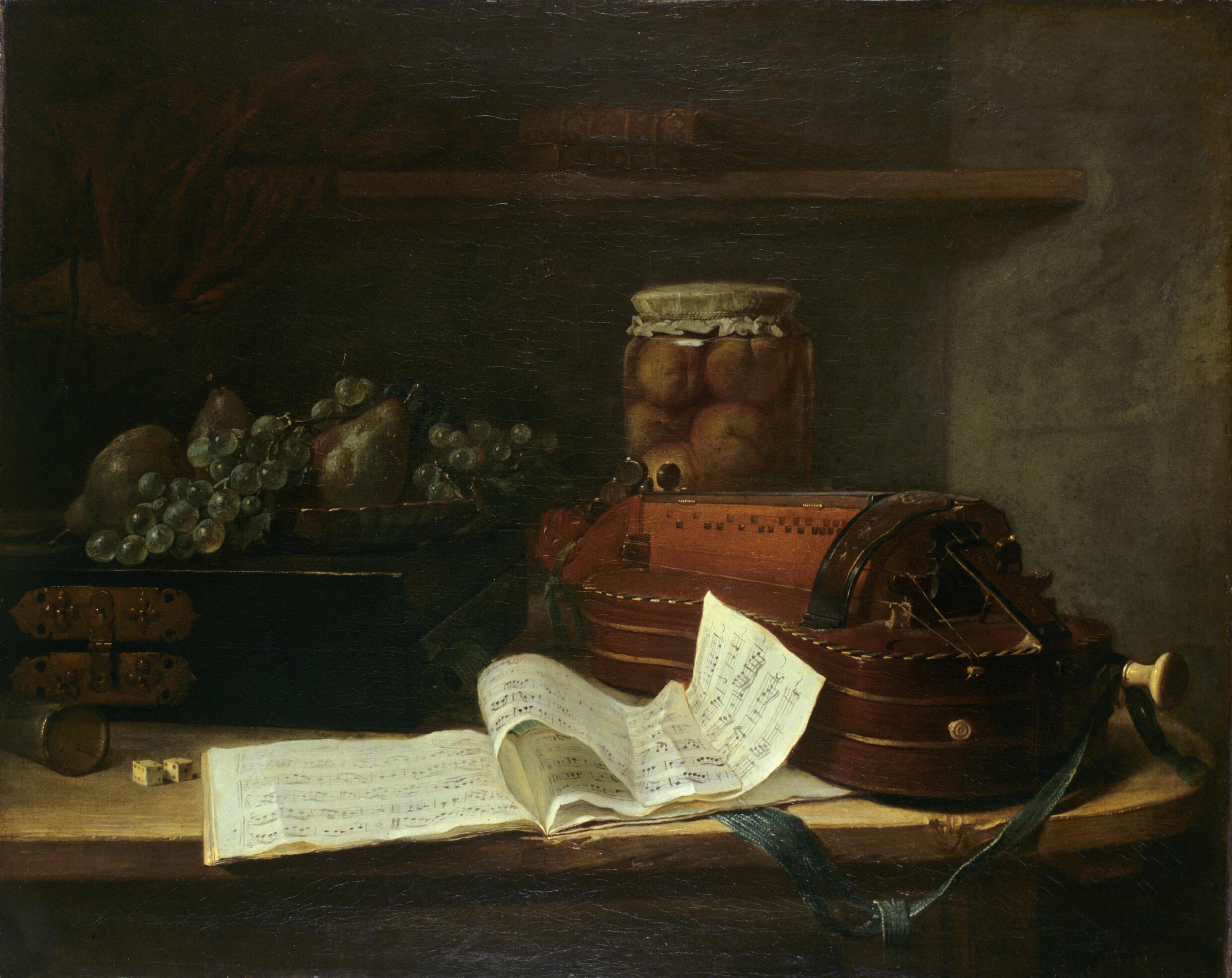
Dating from around 1760, we owe this still-life to the Parisian artist Horace Roland De la Porte, who was a member of the Royal Academy of Painting and Sculpture, specialising in the genre of animals and flowers.
The artist has laid out a variety of symbolic objects on a table here in a tight frame. Rather like a vanity, they evoke the pleasures of life and the fleetingness of human existence. At the centre of the composition is a hurdy gurdy. Originally, this was an instrument played by blind men and beggars and symbolizes the harmonious nature of sound. The crumpled sheet music echoes the books in the background. Represented together these objects symbolize the incompleteness of human knowledge. As for the dice on the left of the painting, they evoke both the pleasure of playing and the unpredictability of fate. Lastly, the pleasure of food and taste are illustrated by the grapes, pears and the jar of peaches or apricots.
In a playful way, this work also functions as an allegory of the five senses. If you look closely at this painting, you can easily match each object to the corresponding sense!