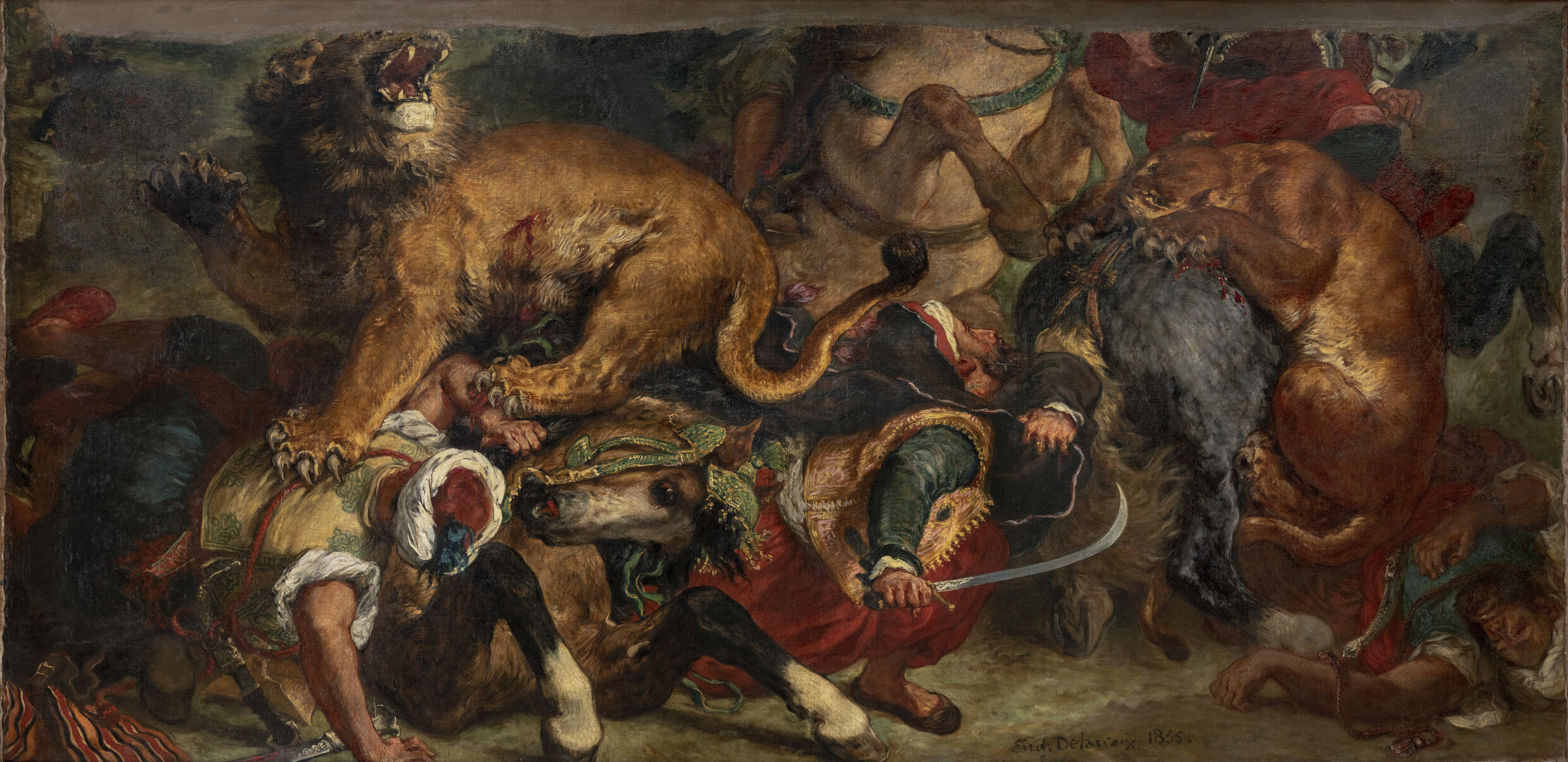
The 7 December 1870 was a disastrous day for this work by Delacroix which had been commissioned for the 1855 World Fair. Indeed, on that day, fire ravaged through the town hall in Bordeaux destroying along with it the upper third of this painting.
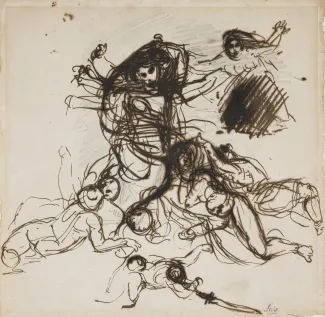
Today, some sketches and copies, and notably one by Odilon Redon, have allowed us to imagine the two missing horse riders that were once in the upper section. Delacroix had studied Rubens’ hunting scenes and was fascinated by the theme of lions. The dimensions of the scene constructed here are spectacular. Not unlike his sculptor friend Barye, whose bronzes you can see in the display cases, Delacroix often frequented the Jardin des Plantes in Paris. His regular visits allowed him to capture not just the beastly force of the fauves, their ferociousness and musculature, but also the colour of their fur and to develop a more authentic and eloquent form of animal art. Similarly to the bright colours, the blue sky on either side of the composition reinforces Baudelaire’s comments about the work: “The Lion Hunt is a veritable explosion of colours”.
This painting is the synthesis of three themes dear to Delacroix’s heart; orientalism, confrontation and animals. Its dramatic theme, the tumultuous movement, spontaneous touch and shimmering colours make it a manifesto of Romantic art.