
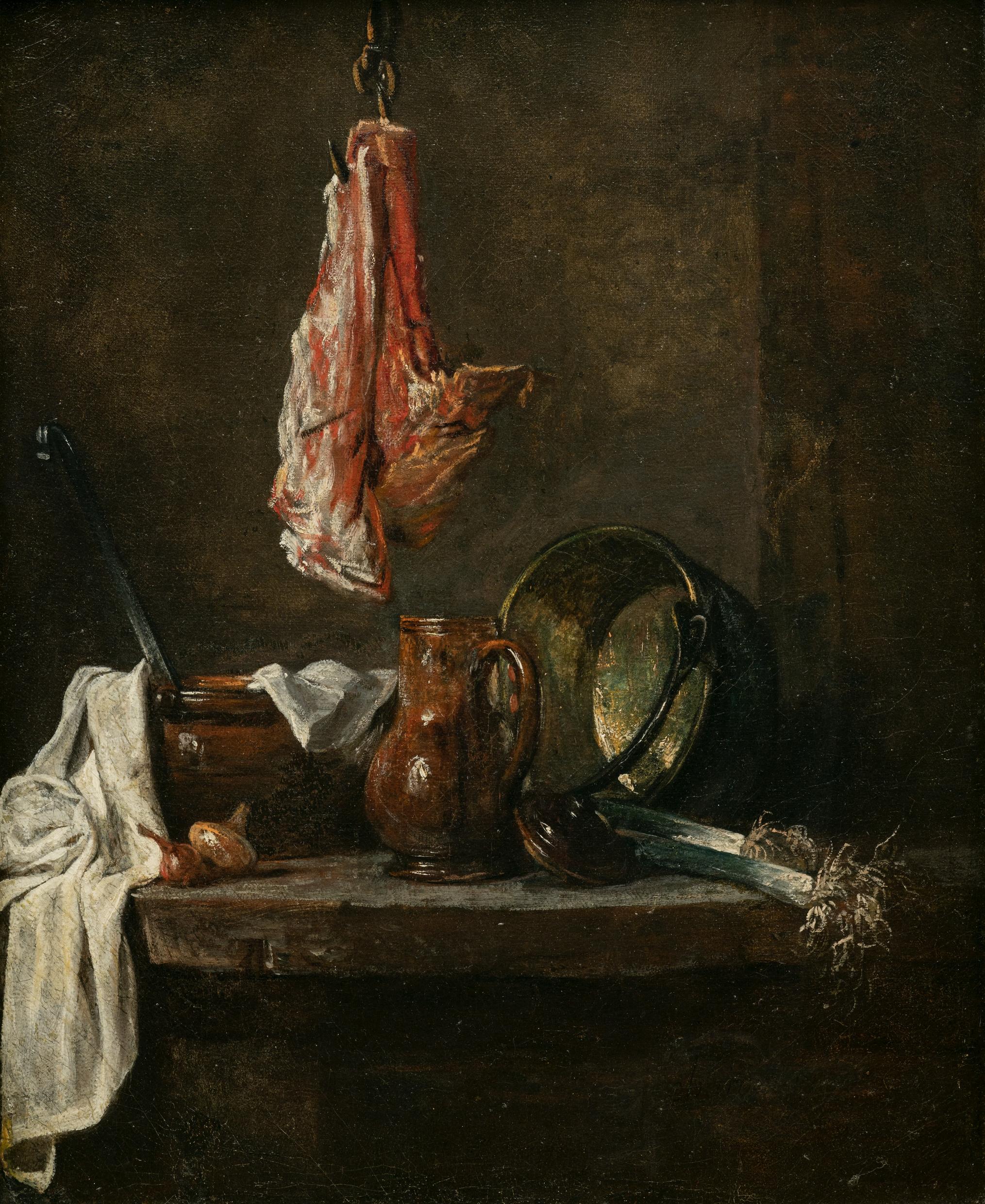
Painted with the greatest attention to detail by Jean Siméon Chardin in 1730, this small work with its pyramid-shaped composition depicts a beautiful still-life of cuts of meat hanging in a kitchen.
Below, the terracotta and copper utensils offer a skilful play of texture and light. In order to give his work more structure, the artist has scattered the composition with touches of white which you can see mainly on the tea towel and the leeks. During the 18th century, Chardin’s simplified compositions were very successful. In 1728, the jury of the Royal Academy of Painting and Sculpture recognised the impressive realism of his work and made him a member. Diderot, who was a great admirer of his work, called him “the great magician” and encouraged painters to observe his work in order to teach them about nature.
Officially a painter of still-lifes, Chardin only touched on the human figure after 1730. From then on, paintings such as Saying Grace or The Morning Toilet were considered to be major works, evoking intimate moments of our human existence and following on from his still-lifes which suggested the presence of man without actually showing it.