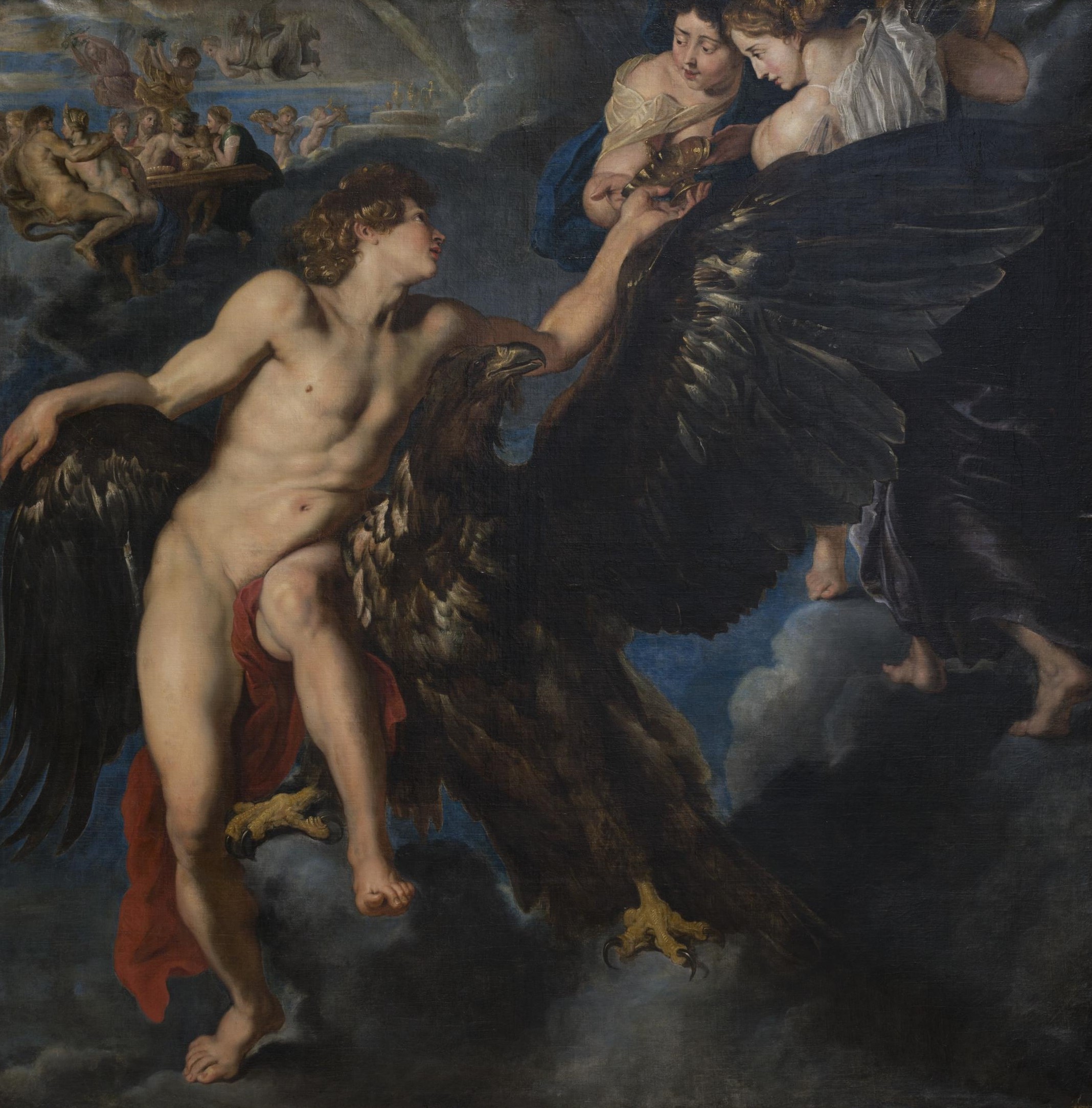
During the 1610s, Rubens treated a number of different mythological subjects and here, he illustrates one of the many transformations of Zeus. The god of Olympus transforms into an eagle in order to abduct one of the most beautiful humans, Ganymede.
In Metamorphoses, Ovid describes the episode: “And just like that batting his deceitful wings in the air, he abducted the descendant of Ilus, who still today mixes the cups and serves nectar to Jupiter, much to Juno’s displeasure.”
However here, the abduction takes backstage and Rubens prefers to sublimate Ganymede’s classical beauty. The young man sits majestically on the eagle’s vast wings. His naked muscular body contrasts with Zeus’ brown-coloured plumage. On Mount Olympus he is welcomed by the gods Hebe and Iris, who offer him the elixir of eternal youth. Both the golden cup and the banquet scene in the background herald his role as cupbearer to the gods, or in other words, the person entrusted to fill their cups. And so, the painting glorifies Ganymede who fills half of the canvas, confirming his future place on Mount Olympus.
Rubens’ work was greatly appreciated in the 17th century and perfectly suited the Baroque tastes of the time.