
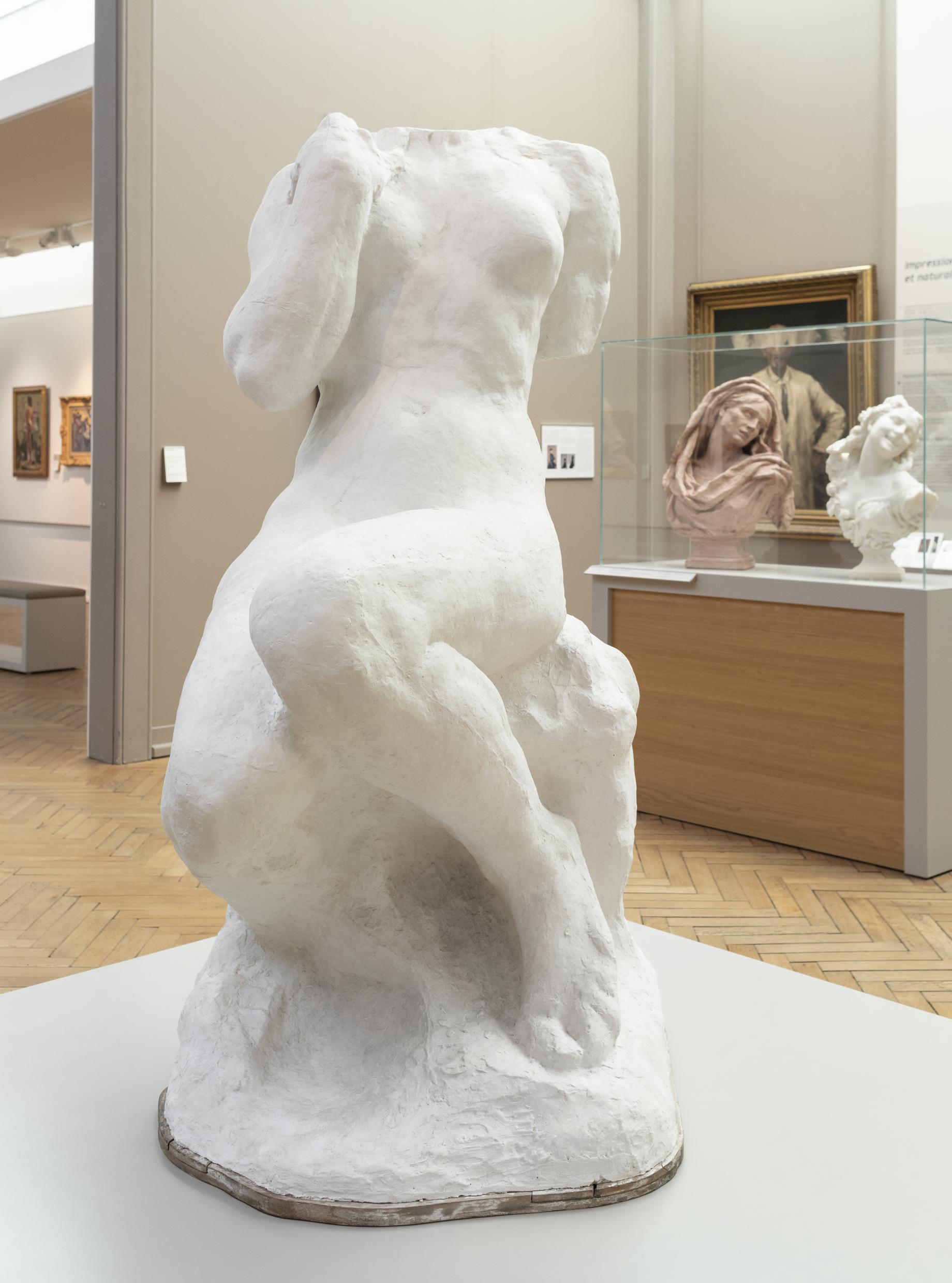
Auguste Rodin was at the height of his career when he made this huge plaster model, entitled Cybel, in 1904.
At the dawn of the 20th century, Rodin revolutionised sculpture with his technical and iconographical innovation and the expressiveness of his figures.
Here, he has drawn inspiration from a small 51cm seated figure with arms and legs which he probably made some twenty years earlier from clay. It was just one of a multitude of entwined characters on the Gates of Hell, a monumental bronze door intended for the future Museum of Decorative Arts. With this sculpture Rodin affirms his desire to create a completely unique work.
He entrusted one of his assistants, Henri Lebossé, to make a huge plaster version by enlarging the original sculpture using mathematical processes and techniques that the latter had invented himself. Rodin’s avant-gardism is evident: the left arm and the head of the statue are missing, the seams of the mould have been left apparent and the surface of the body has been left untouched with traces of working and the raw material. The undulating lines, and the movement of the body constrained in an awkward position, reveal the sensuality of this nude.
This sculpture came into the museum’s collections in 1906. At that time, Bordeaux was one of the first French towns to house a work by Rodin during his lifetime.