
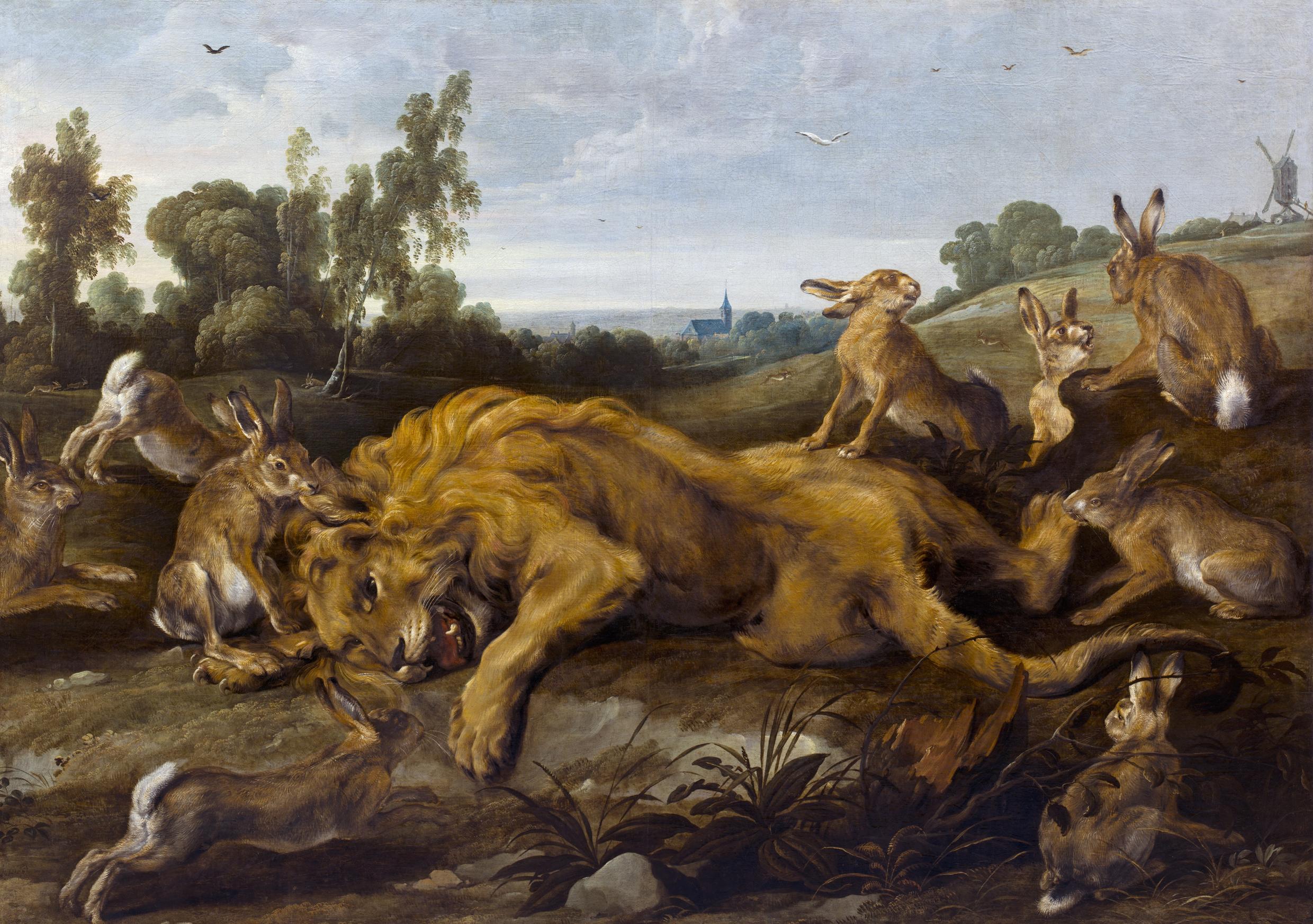
In the 17th century, the genre of animal painting was very popular in Flanders. Several artists in the Netherlands specialised in this kind of iconography; Frans Snyders, who was one of the most iconic figures in this genre had a reputation that knew no borders.
This monumental work, which has the artist’s signature on the lion’s tail, shows the extent of his talent. Set in a typically Flemish landscape, punctuated by a church steeple and a windmill, a lion is stretched out with his mouth wide open. Rather curiously, the huge, motionless feline is being attacked by hares who encircle him on all sides.
You may be wondering how this majestic, exotic animal found itself in this northern environment? The explanation can be found in the illustrated books of emblems of the time. These engraved works were very popular back then and some illustrated the bestiary of Aesop, a fable teller from the 6th century BC. Moreover, Aesop influenced other authors contemporary with Snyders, like Jacob Cats in the Netherlands or La Fontaine in France. In Jacob Cats’ work, the dead lion, taunted by the hares, is a warning against powerful tyrants.
With this mise en scene, the author evokes the inevitable destitution of the great when they no longer respect the ordinary folk. In this image, the hares embody the people, who no longer fear the slayed lion, the symbol of fallen power.