
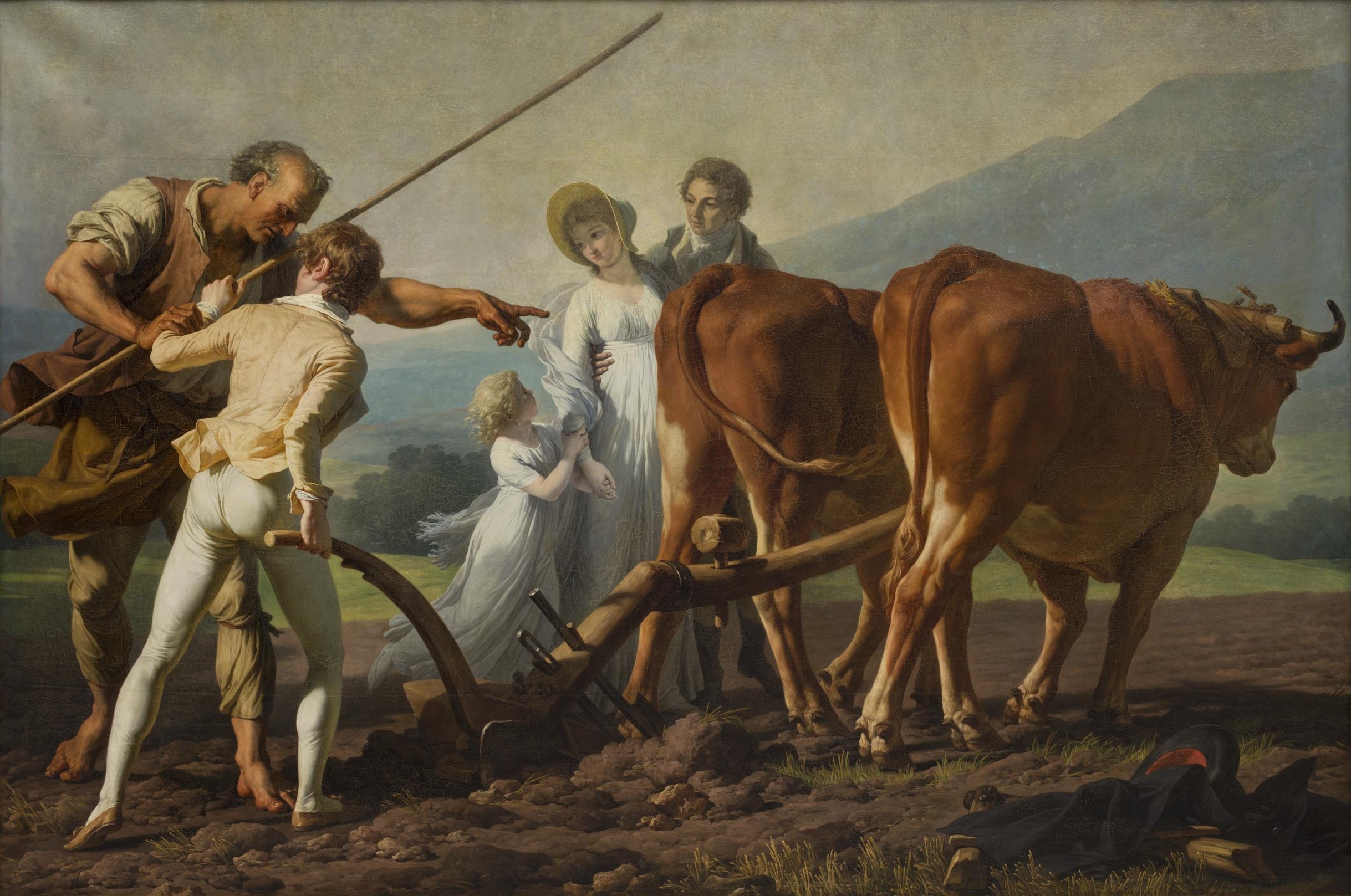
The Neoclassical artist François-André Vincent played an essential role in the history of French painting.
A pupil of Joseph-Marie Vien, similarly to Pierre Lacour and Taillasson, this contemporary and rival of David presented this painting entitled, Agriculture, at the 1798 Salon.
Behind this simple title, Vincent has staged the commissioner of the work, François-Bernard Boyer-Fonfrède in the scene. And so, the latter, who was born into a rich family of merchants from Bordeaux, can be seen along with his wife and daughter who are watching the son’s ploughing lesson.
As you can see, the painter uses a cold colour palette and seeks to meet the expectations of his patron with his perfect execution. To do this, he drew inspiration from ancient sculpture, setting the ploughing lesson on his client’s estate in Occitany, with the Pyrenees Mountains as a backdrop. The subject of the composition and the way it is expressed were nourished by physiocratic thinking, which in line with Enlightenment concepts, justified working on the land. Indeed, in his treaty, Emile or On Education, published in 1762, Jean-Jacques Rousseau, explained that farming, considered as the “most important of man’s tasks”, was a good way of being virtuous. And so, for François-Bernard Boyer-Fonfrède, his son’s education was incomplete “without this skill”.