
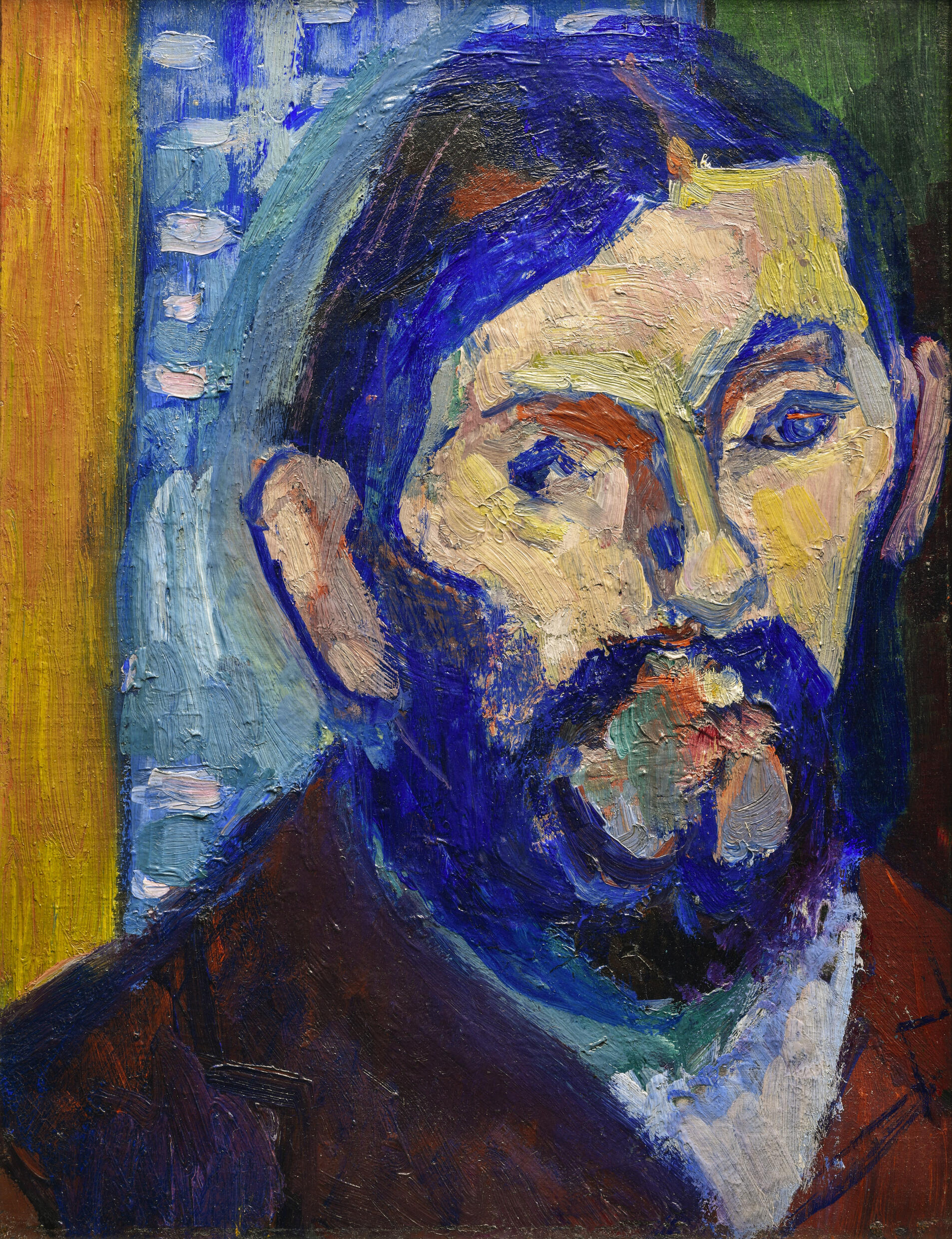
When this work was made in 1901, Matisse was experimenting with using colour to construct his compositions rather than just as a secondary element to drawing. The arbitrarily chosen colours make the famous face of the Italian model, Pignatelli, alias Bevilacqua, stand out from the blue ground.
Matisse particularly appreciated the physiognomy of this farmer, originally from Abruzzo, and painted him on several occasions between 1900 and 1903. The portrait, set slightly off centre to the right of the work, presents the angular face, rendered in a highly synthetic manner through the use of cleverly positioned, coloured touches.
As you can see, Matisse uses nothing more than a broad orange brushstroke to suggest the bridge of his nose and the line of his eyebrow arch. As for his chin, it appears almost sculpted by layers of green, orange and mauve touches. Matisse uses impasto, or thicker layers of colour, to give depth to his work and create an outline for the mouth. The warm colours of the face and contour of the eyes echo the model’s Mediterranean origins.
This pictorial experimentation heralded the scandal that would provoke the bold coloured works produced by Matisse and his friends at the Salon d’Automne in 1905, considered to be the founding act of Fauvism.