
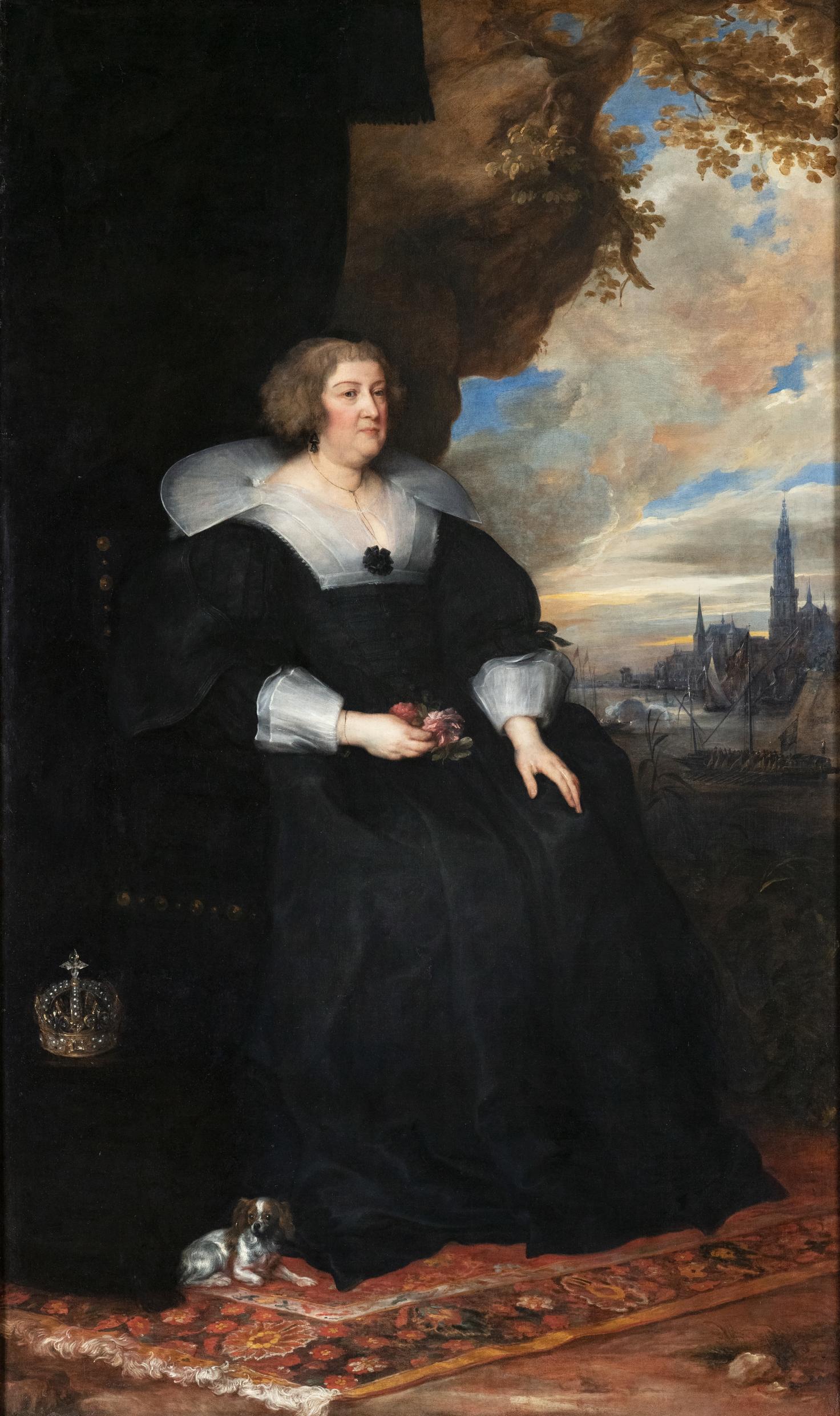
When Anton Van Dyck painted this portrait in 1631, the former queen and regent of France Marie de Medici was in exile. She had lost her influence over her son, King Louis XIII during the “Day of the Dupes” which took place on 30 November 1630. On that day, she demanded her son to dismiss Cardinal Richelieu. Against all expectations, the King of France favoured his minster saying: “I am more attached to my state than my mother”! Now her son’s number one enemy, Marie de Medici took refuge in the Spanish Basque Country.
Marie de Medici looks very regal in this official portrait painted in Antwerp by Anton Van Dyck, a Dutch painter with a growing reputation. The artist has idealised his model, dressed in a black mourning gown and holding a bouquet of roses, majestically seated on her throne. To evoke her situation, the royal crown is placed at her side rather than on her head. However, Marie de Medici does not appear vanquished. The presence of her dog in the foreground on the left, a symbol of loyalty, highlights her on-going devotion to the Kingdom of France, reinforced further by the fleurs de lys motif on the curtain behind her.