
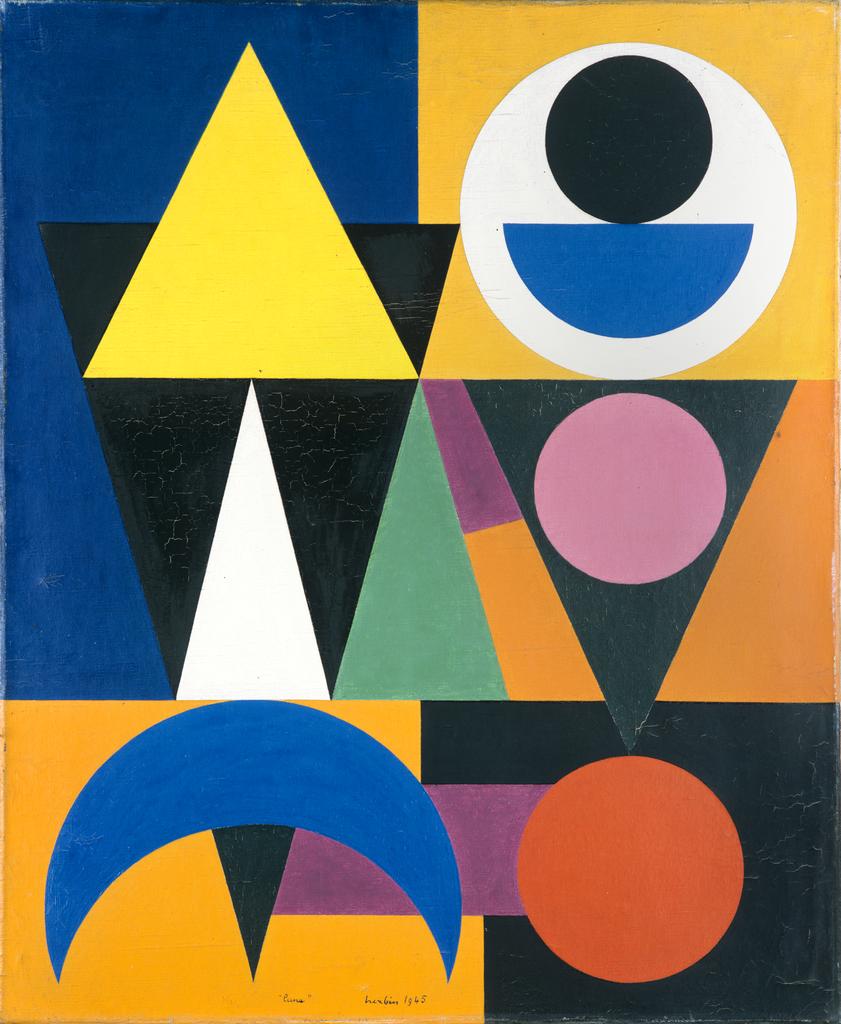
You are now facing an oil painting by Auguste Herbin.
In 1945, the painter developed a “plastic alphabet” to compose his works. This was based on a choice of simple forms, squares, rectangles, triangles, circles and half-circles, but also primary and complementary colours, as well as black and white. The artist added letters and musical notes to these elements.
The letters from the word-title chosen for this work determined most of the forms and colours the artist used. And so, in this painting entitled Moon or Lune in French, the yellow triangle corresponds to the letter “L”, the half-circle to the “U”, the white circle and triangle “N” and the red circle to the “E”.
Amusingly, the pronunciation of the word comes into play when you look at the composition. Designed in this way, the painting-word reveals the very essence of things. Through this play of figures and colours, the different planes blend together, giving the composition a movement that attracts our eye. According to the artist it is “by renouncing the object, [that] we find creative speech and action”.