
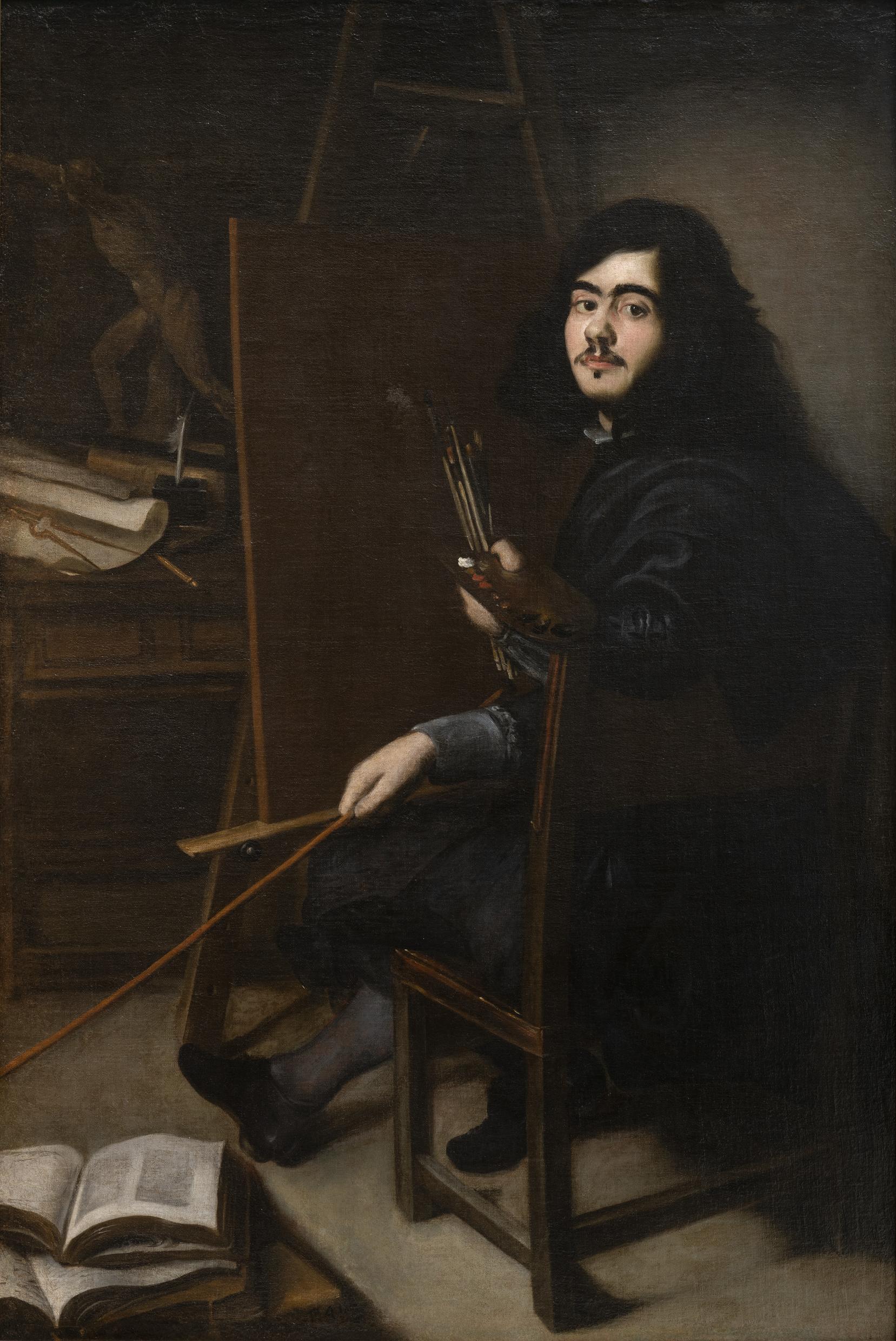
The self-portrait you are looking at now is an ode to the art of painting!
We owe this unique work to the 17th-century Spanish artist Pedro de Moya, little represented In French museums.
Moya trained under the Sevillian painter Juan del Castillo and like his compatriot Murillo, Moya left his homeland to perfect his art and travelled as a soldier to Flanders. There, he became familiar with the work of artists such as Rubens and Van Dyck, whom he followed to London. Enriched by this experience, the painter returned home to Spain and specialised in religious painting. This self-portrait was undoubtedly made on his return.
Sitting in front of a blank canvas placed on his easel, Moya looks out at us, welcoming us into his studio. Inspired by the books on the floor and on the verge of starting his composition, he is holding a brush, palette and maulstick in his hand. Behind the easel on the desk, studies, compass and pen holder attest to the research carried out for his painting. The cast of an ancient statue of a gladiator discovered at the beginning of the century and admired across Europe, suggests he was about to begin a history painting. By illustrating his intellectual process in this way, Moya follows in a long line of scholarly artists who, since the Renaissance, had considered painting as a “liberal art”.