
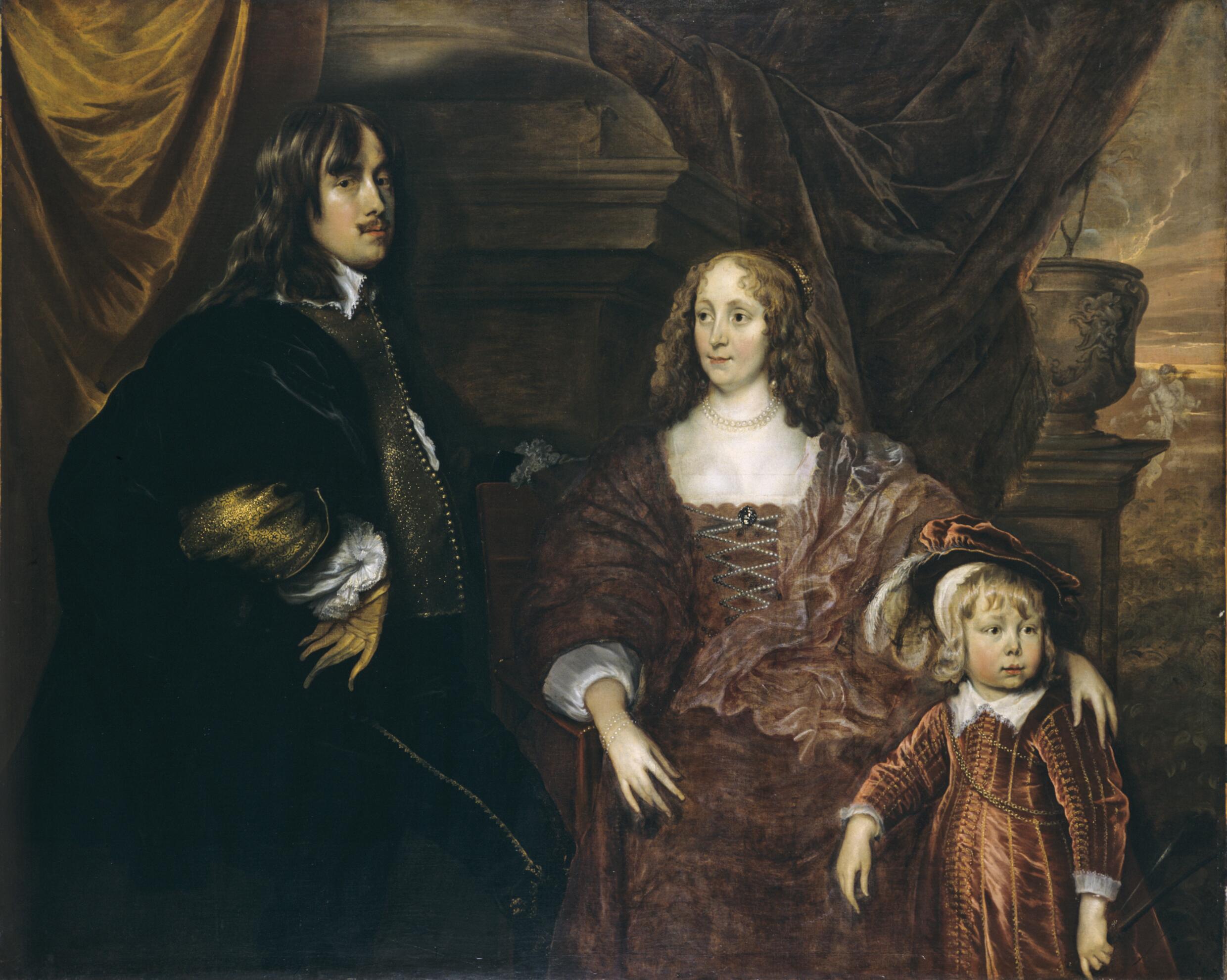
The style of this painting attributed to Adriaen Hanneman echoes the art of some of the great portrait artists who influenced his work like Anton Van Dyck or Daniel Mytens. In the 17th century, the genre of portrait saw an unprecedented development in Holland. Countless bourgeois families commissioned them in order to promote their social and economic success.
The unknown family represented here, are depicted in a rich setting surrounded by heavy moiré tenting and opening out onto a dusky landscape. The positioning of each family member reflects their social rank. The man, at the head of the family, is staring out at us, reminding us of his comfortable social position. He stands taller than his wife who is looking back at him. The latter, whose main role was to look after the household and the children, has her hand on her son’s shoulder. The fashion at that time often afforded young boys the attributes of Love or the hunter. Here, he has a bow and arrow in his left hand. Little girls were often given the attributes of a shepherdess.
As you can see on the description, this canvas is stamped MNR or National Museums Recuperation. This acronym means that the work was seized by the Nazis during the Second World War and then deposited by the State in French museums awaiting return to its rightful owners or their heirs. The Bordeaux Museum of Fine Arts houses ten such works in total.